
The Hidden Carbon Footprint of Professional Services: Travel, Tech, and Office Operations

Will Marshall
Tuesday, September 9, 2025 • 4 min read
When people picture industries with heavy carbon footprints, they often think of aviation, manufacturing, or logistics. Professional services - law firms, consultancies, accountancies, design studios - are frequently seen as “low-impact” by comparison. After all, they don’t produce steel, ship goods, or run factories. Yet the reality is that office-based sectors carry their own large hidden carbon footprint.
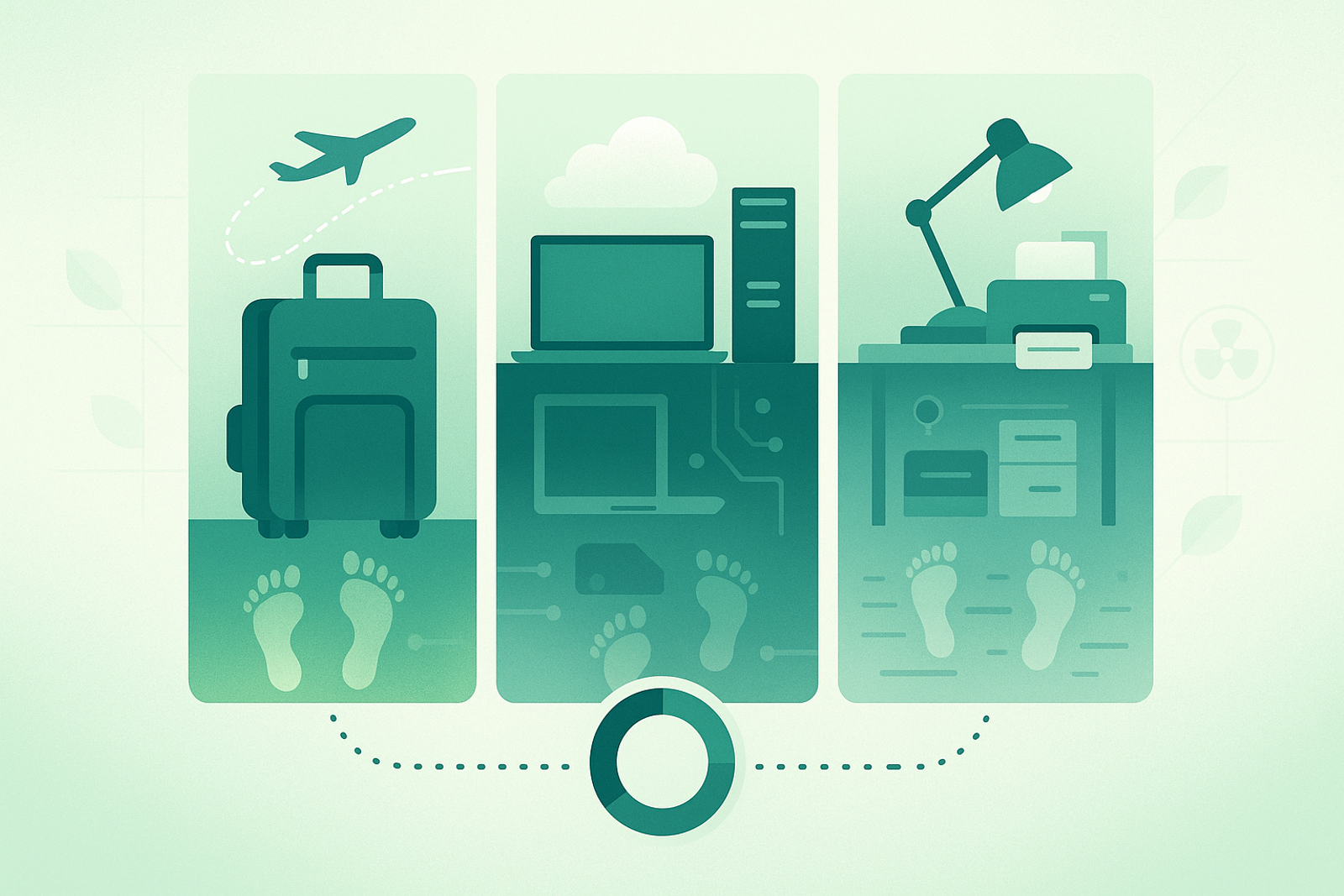
The main culprits? Travel, technology, and office operations. Individually, each may appear modest. Combined across thousands of employees and projects, they represent a material share of emissions that service-sector firms can’t afford to ignore, especially under frameworks like the EU CSRD, UK SECR, or the GHG Protocol.
Business Travel: The Elephant in the Room
Client meetings, conferences, and site visits are central to professional services. But air travel and even frequent train journeys contribute significantly to Scope 3 emissions. Business travel often dwarfs a firm’s direct Scope 1 and 2 footprint.
The good news is that these emissions are among the easiest to measure. Travel expenses flow through accounting systems, and with a transaction-based carbon footprinting approach you can map each booking to emissions factors. This avoids manual mileage logs or complex travel surveys, while providing a foundation for reduction strategies such as rail-over-air policies or virtual meeting adoption.
For finance teams that want a practical walkthrough, we’ve also created a step-by-step guide to connecting financial data to emissions.
The Carbon Cost of Technology
Professional services run on digital tools: laptops, servers, cloud platforms, and video conferencing. Yet digital doesn’t mean carbon-free. Manufacturing and powering IT equipment contributes substantial embodied and operational emissions.
Cloud services are especially significant. While hyperscale providers are moving towards renewable power, the carbon footprint of data storage and transfer is non-trivial. For example, routine video calls generate ongoing emissions, which scale with usage.
Tracking these emissions is less straightforward, but input-output methodology carbon accounting provides defensible estimates from spend on IT, software subscriptions, and outsourced services. As supplier-specific data becomes available (e.g. a cloud vendor’s published emissions factors), you can refine accuracy, a principle we call progressive carbon footprint refinement.
Office Operations: More Than Just Lights and Heating
The modern office is a hub of indirect emissions. Heating, cooling, cleaning, and even catered lunches all add up. While landlords may report building-level energy use, service firms often overlook Scope 3 categories such as waste management, courier services, and office supplies.
Here, cost-based emissions factors are especially powerful. Spend data on electricity, gas, cleaning contracts, or stationery can be quickly converted into a baseline footprint. From there, organisations can prioritise improvements: switching to renewable energy tariffs, reducing single-use products, or adopting shared office spaces to lower per-capita impacts.
Why It Matters
For professional services firms, sustainability isn’t just about compliance. Clients are increasingly asking suppliers to disclose emissions and climate policies. Firms that can demonstrate robust measurement, not just glossy pledges, stand out in procurement processes.
Equally, employees expect their workplace to reflect their values. A credible carbon management programme can support recruitment and retention, particularly among younger talent.
How to Take Action
The first step is simple: start measuring with the data you already have. By linking financial transactions to emissions factors, firms can build a defensible carbon footprint in days, not months. From there, accuracy can be refined over time, moving from default factors to supplier and product-specific data.
This approach not only meets regulatory requirements but also highlights reduction opportunities; whether that’s reducing flights, optimising IT procurement, or adopting greener office practices.
If you want to explore software that does this automatically, see our earlier blog on why your business needs carbon footprint tracking software.